Things Fall Apart

Most people read Things Fall Apart by Chinua Achebe in high school. I am not sure why it wasn’t on my syllabus, but I have had it on my radar for a long time. I believe it is also generally regarded as one of the best books of the century. I, however, didn’t love it. It was short enough that I plowed through, and I can see why it would be good to read, especially in a class where it could be analyzed. But, it didn’t particularly hold my interest (granted, I am still trying to blow through my books at the end of the year with the goal of 100 by tomorrow and grabbed this one as a quick way to accomplish that – perhaps not the best way to read, but…). “Things Fall Apart is the first of three novels in Chinua Achebe’s critically acclaimed African Trilogy. It is a classic narrative about Africa’s cataclysmic encounter with Europe as it establishes a colonial presence on the continent. Told through the fictional experiences of Okonkwo, a wealthy and fearless Igbo warrior of Umuofia in the late 1800s, Things Fall Apart explores one man’s futile resistance to the devaluing of his Igbo traditions by British political and religious forces and his despair as his community capitulates to the powerful new order. With more than 20 million copies sold and translated into fifty-seven languages, Things Fall Apart provides one of the most illuminating and permanent monuments to African experience. Achebe does not only capture life in a pre-colonial African village, he conveys the tragedy of the loss of that world while broadening our understanding of our contemporary realities.” (Amazon) Clearly, reading this review, I missed the boat on this one.

The Nine Lives of Rose Napolitano

The Nine Lives of Rose Napolitano by Donna Freitas is another book I had on my list that Gayle Weiswasser posted on her best of the year list, so, as it also came available to me from the library, it was added to the “must read before the end of 2021” pile. “Rose Napolitano is fighting with her husband, Luke, about prenatal vitamins. She promised she’d take them, but didn’t. He promised before they got married that he’d never want children, but now he’s changed his mind. Their marriage has come to rest on this one question: Can Rose find it in herself to become a mother? Rose is a successful professor and academic. She’s never wanted to have a child. The fight ends, and with it their marriage. But then, Rose has a fight with Luke about the vitamins–again. This time the fight goes slightly differently, and so does Rose’s future as she grapples with whether she can indeed give up the one thing she thought she knew about herself. Can she reimagine her life in a completely new way? That reimagining plays out again and again in each of Rose’s nine lives, just as it does for each of us as we grow into adulthood. What are the consequences of our biggest choices? How would life change if we let go of our preconceived ideas of ourselves and became someone completely new? Rose Napolitano’s experience of choosing and then choosing again shows us in an utterly compelling way what it means, literally, to reinvent a life and, sometimes, become a different kind of woman than we ever imagined.” (Amazon) This was a really cool book. The nine options for the way life plays out kept weaving in and out and back again. I should have written a chart to keep track of which was which. That would have made me like the book even better, I think. I really, really liked this book, but I didn’t LOVE it. I LOVED the ending and the way things tied together and I thought it was really creative, but something holds me back from giving it best of the year. I can’t quite put my finger on it, but it falls into the way too long 4.5-star category for me. Definitely read it, but, for me, not 5-star worthy quite.

Count the Ways

Count the Ways by Joyce Maynard was already on my TBR list, but when it was recommended as a best book of the year by my favorite blogger, Gayle Weiswasser here, I moved it to the top of the list. I have enjoyed Maynard’s books in the past (Under the Influence, After Her, and Labor Day – before I was reviewing books), so I imagined this one would also be a winner. While I liked it a lot, it wasn’t five-star for me. Close, but it was a little too depressing and a little longer than it needed to be, in my opinion. Well worth reading, but not the best of the best. Amazon: “Eleanor and Cam meet at a crafts fair in Vermont in the early 1970s. She’s an artist and writer, he makes wooden bowls. Within four years they are parents to three children, two daughters and a red-headed son who fills his pockets with rocks, plays the violin and talks to God. To Eleanor, their New Hampshire farm provides everything she always wanted—summer nights watching Cam’s softball games, snow days by the fire and the annual tradition of making paper boats and cork people to launch in the brook every spring. If Eleanor and Cam don’t make love as often as they used to, they have something that matters more. Their family. Then comes a terrible accident, caused by Cam’s negligence. Unable to forgive him, Eleanor is consumed by bitterness, losing herself in her life as a mother, while Cam finds solace with a new young partner.  Over the decades that follow, the five members of this fractured family make surprising discoveries and decisions that occasionally bring them together, and often tear them apart. Tracing the course of their lives—through the gender transition of one child and another’s choice to completely break with her mother—Joyce Maynard captures a family forced to confront essential, painful truths of its past, and find redemption in its darkest hours.”

It Ends With Us

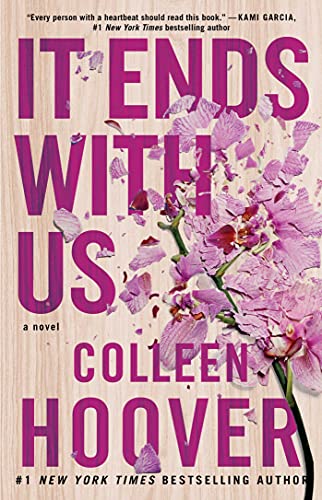
It Ends With Us by Colleen Hoover has been on my shelf for a while. I can’t remember if someone gave it to me or I found it in the LFL. In any event, I read a positive review of it just recently and, both trying to continue the bookshelf purge AND looking for quick reads so I can make it to my 100 goal in the next five days (!!) it grabbed my attention. What a book. It’s really sad and somewhat simple and easy to predict, but I really enjoyed it and breezed through it in a few hours. Amazon: “Lily hasn’t always had it easy, but that’s never stopped her from working hard for the life she wants. She’s come a long way from the small town in Maine where she grew up – she graduated from college, moved to Boston, and started her own business. So when she feels a spark with a gorgeous neurosurgeon named Ryle Kincaid, everything in Lily’s life suddenly seems almost too good to be true. Ryle is assertive, stubborn, and maybe even a little arrogant. He’s also sensitive, brilliant, and has a total soft spot for Lily, but Ryle’s complete aversion to relationships is disturbing. As questions about her new relationship overwhelm her, so do thoughts of Atlas Corrigan – her first love and a link to the past she left behind. He was her kindred spirit, her protector. When Atlas suddenly reappears, everything Lily has built with Ryle is threatened.” I highly recommend this one, as hard as it is to read. My only reason to give it less than five stars was that it was a little too predictable.

Missing, Presumed

The great bookshelf purge continues. Next up, Missing, Presumed by Susie Steiner. “At thirty-nine, Manon Bradshaw is a devoted and respected member of the Cambridgeshire police force, and though she loves her job, what she longs for is a personal life. Single and distant from her family, she wants a husband and children of her own. One night, after yet another disastrous Internet date, she turns on her police radio to help herself fall asleep—and receives an alert that sends her to a puzzling crime scene. Edith Hind—a beautiful graduate student at Cambridge University and daughter of the surgeon to the Royal Family—has been missing for nearly twenty-four hours. Her home offers few clues: a smattering of blood in the kitchen, her keys and phone left behind, the front door ajar but showing no signs of forced entry. Manon instantly knows that this case will be big—and that every second is crucial to finding Edith alive. The investigation starts with Edith’s loved ones: her attentive boyfriend, her reserved best friend, her patrician parents. As the search widens and press coverage reaches a frenzied pitch, secrets begin to emerge about Edith’s tangled love life and her erratic behavior leading up to her disappearance. With no clear leads, Manon summons every last bit of her skill and intuition to close the case, and what she discovers will have shocking consequences not just for Edith’s family but for Manon herself.” (Amazon) I will admit I only finished this one to find out what happened. It wasn’t particularly gripping, though the back half was better than the first. The middle really dragged. I’m not going to be grabbing the next two in the series.

Matrix

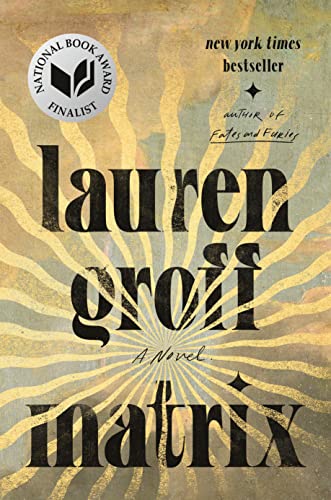
Matrix by Lauren Groff has been everywhere this year and Obama chose it as one of his favorite books of 2021. So, I was excited that a friend loaned it to me (the friend did remark that she didn’t like it much). Nor did I. What a disappointment. “Cast out of the royal court by Eleanor of Aquitaine, deemed too coarse and rough-hewn for marriage or courtly life, seventeen-year-old Marie de France is sent to England to be the new prioress of an impoverished abbey, its nuns on the brink of starvation and beset by disease. At first taken aback by the severity of her new life, Marie finds focus and love in collective life with her singular and mercurial sisters. In this crucible, Marie steadily supplants her desire for family, for her homeland, for the passions of her youth with something new to her: devotion to her sisters, and a conviction in her own divine visions. Marie, born the last in a long line of women warriors and crusaders, is determined to chart a bold new course for the women she now leads and protects. But in a world that is shifting and corroding in frightening ways, one that can never reconcile itself with her existence, will the sheer force of Marie’s vision be bulwark enough?” (Amazon) While this didn’t take long to read, I wish I hadn’t bothered.

The Paris Secret

I will admit to reading some short books at the end of the year in hopes of meeting my yearly book reading goal. I have fallen short of my 100 and figured if I crammed in a bunch of short ones, I might just squeak in. I have avoided WWII books for a while, but because this one was so short, I grabbed it anyway. The Paris Secret by Lily Graham was a quick, sad, but hopeful read. “The last time Valerie was in Paris, she was three years old, running from the Nazis, away from the only home she had ever known.Now as a young woman all alone in the world, Valerie must return to Paris, to the bookshop and her sole surviving relative, her grandfather Vincent, the only person who knows the truth about what happened to her parents. As she gets to know grumpy, taciturn Vincent again, she hears a tragic story of Nazi-occupied Paris, a doomed love affair and a mother willing to sacrifice everything for her beloved daughter.” (Amazon) While this was a good read, it wasn’t anything incredible. It was captivating, nonetheless.

South of Broad

South of Broad by Pat Conroy has been on my shelf for a very long time. As it kept getting put aside for library books or new books, I kept thinking about it and wondering if it was worth reading. I did a major TBR bookshelf cull last year, and still South of Broad stayed on the shelf. For some reason, this seemed to be the time to hunker down and read it. It’s long – my only complaint and why it doesn’t get five stars – but worth it. Amazon: “Leopold Bloom King has been raised in a family shattered—and shadowed—by tragedy. Lonely and adrift, he searches for something to sustain him and finds it among a tightly knit group of outsiders. Surviving marriages happy and troubled, unrequited loves and unspoken longings, hard-won successes and devastating breakdowns, as well as Charleston, South Carolina’s dark legacy of racism and class divisions, these friends will endure until a final test forces them to face something none of them are prepared for.” I do generally love a family/friendship saga over time and this was one. And, there were twists and surprises, which made you want to keep reading. It’s not a quick read, but it’s a very enjoyable one.

Miss Benson’s Beetle

Several people recommended Miss Benson’s Beetle by Rachel Joyce to me (remind me who you are if you read this). And, boy am I glad they did. I have liked Joyce’s work in the past (The Music Shop and The Unlikely Pilgrimage of Harold Fry, though I didn’t enjoy Perfect) and am not sure how I missed this one. Amazon: “It is 1950. London is still reeling from World War II, and Margery Benson, a schoolteacher and spinster, is trying to get through life, surviving on scraps. One day, she reaches her breaking point, abandoning her job and small existence to set out on an expedition to the other side of the world in search of her childhood obsession: an insect that may or may not exist—the golden beetle of New Caledonia. When she advertises for an assistant to accompany her, the woman she ends up with is the last person she had in mind. Fun-loving Enid Pretty in her tight-fitting pink suit and pom-pom sandals seems to attract trouble wherever she goes. But together these two British women find themselves drawn into a cross-ocean adventure that exceeds all expectations and delivers something neither of them expected to find: the transformative power of friendship.” I thoroughly enjoyed this story, though it was a little draggy in one section, hence the 4.5- rather than 5-stars.

On Juneteenth

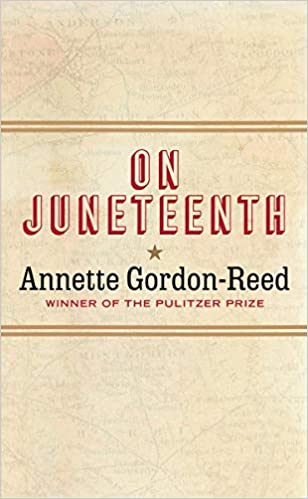
On Juneteenth by Annette Gordon-Reed is a wonderful intertwining of the author’s personal history and the history of Texas. She deftly slips back and forth between the two to explain why she loves a state so fraught historically and for people of color specifically. “Weaving together American history, dramatic family chronicle, and searing episodes of memoir, Annette Gordon-Reed’s On Juneteenth provides a historian’s view of the country’s long road to Juneteenth, recounting both its origins in Texas and the enormous hardships that African-Americans have endured in the century since, from Reconstruction through Jim Crow and beyond. All too aware of the stories of cowboys, ranchers, and oilmen that have long dominated the lore of the Lone Star State, Gordon-Reed―herself a Texas native and the descendant of enslaved people brought to Texas as early as the 1820s―forges a new and profoundly truthful narrative of her home state, with implications for us all.” (Amazon) Amazon’s description is quite long and I did not include it all here, but this spare work is a powerful one and well-worth picking up, especially if you don’t know this history already.