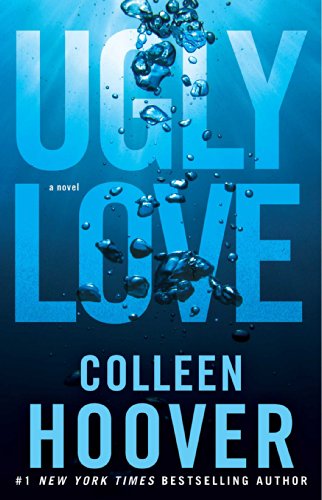
Ugly Love by Colleen Hoover was not a favorite. While I have liked her others (and they are certainly beach reads: November 9, It Ends with Us, Verity), this one was only good at the end. Otherwise, I would give it a pass. “When Tate Collins meets airline pilot Miles Archer, she doesn’t think it’s love at first sight. They wouldn’t even go so far as to consider themselves friends. The only thing Tate and Miles have in common is an undeniable mutual attraction. Once their desires are out in the open, they realize they have the perfect set-up. He doesn’t want love, she doesn’t have time for love, so that just leaves the sex. Their arrangement could be surprisingly seamless, as long as Tate can stick to the only two rules Miles has for her: never ask about the past, don’t expect a future. They think they can handle it, but realize almost immediately they can’t handle it at all.” (Amazon)
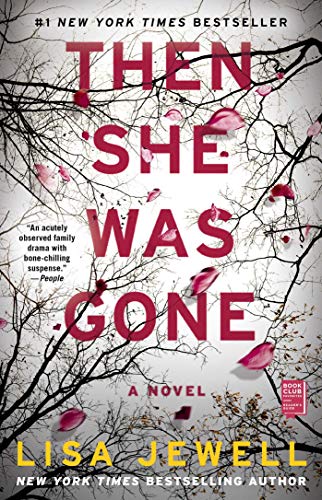
I only have six books left in the “Great Bookshelf Purge.” To be fair, I have not read a huge portion of those that have sat around on my shelf for however many years. I read about 10 pages of many of them and said, “nope – not interested.” Then She Was Gone by Lisa Jewell, however, I did stick with. Like most of Jewell’s books, this one kept you on the edge of your seat until the very (surprising) end. “Ellie Mack was the perfect daughter. She was fifteen, the youngest of three. Beloved by her parents, friends, and teachers, and half of a teenaged golden couple. Ellie was days away from an idyllic post-exams summer vacation, with her whole life ahead of her. And then she was gone. Now, her mother Laurel Mack is trying to put her life back together. It’s been ten years since her daughter disappeared, seven years since her marriage ended, and only months since the last clue in Ellie’s case was unearthed. So when she meets an unexpectedly charming man in a café, no one is more surprised than Laurel at how quickly their flirtation develops into something deeper. Before she knows it, she’s meeting Floyd’s daughters—and his youngest, Poppy, takes Laurel’s breath away. Because looking at Poppy is like looking at Ellie. And now, the unanswered questions she’s tried so hard to put to rest begin to haunt Laurel anew. Where did Ellie go? Did she really run away from home, as the police have long suspected, or was there a more sinister reason for her disappearance? Who is Floyd, really? And why does his daughter remind Laurel so viscerally of her own missing girl?” (Amazon) If you like a thriller, this is a decent one.
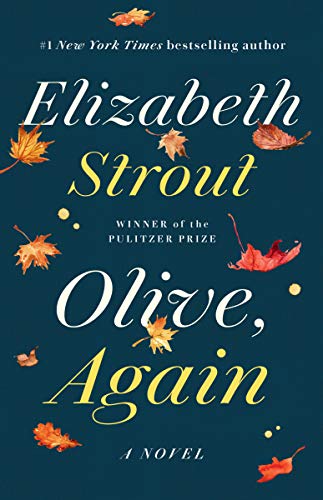
Olive, Again by Elizabeth Strout was in my Little Free Library a while ago and it has been on my bookshelf ever since. I had liked the original, so I finally plunged into this new one. “Prickly, wry, resistant to change yet ruthlessly honest and deeply empathetic, Olive Kitteridge is ‘a compelling life force’ (San Francisco Chronicle). TheNew Yorker has said that Elizabeth Strout ‘animates the ordinary with an astonishing force,’ and she has never done so more clearly than in these pages, where the iconic Olive struggles to understand not only herself and her own life but the lives of those around her in the town of Crosby, Maine. Whether with a teenager coming to terms with the loss of her father, a young woman about to give birth during a hilariously inopportune moment, a nurse who confesses a secret high school crush, or a lawyer who struggles with an inheritance she does not want to accept, the unforgettable Olive will continue to startle us, to move us, and to inspire us—in Strout’s words—’to bear the burden of the mystery with as much grace as we can.'” (Amazon) It’s a good book and easy to pick up and put down. I enjoyed it.
Want to tackle a 620 page tome in your spare time? Cloud Cuckoo Land by Anthony Doerr is your book. It’s my first five star book of the year. I have to include the whole long Amazon review because just reading about the plot doesn’t do the book justice. “Among the most celebrated and beloved novels of 2021, Anthony Doerr’s gorgeous third novel is a triumph of imagination and compassion, a soaring story about children on the cusp of adulthood in worlds in peril, who find resilience, hope—and a book. In Cloud Cuckoo Land, Doerr has created a magnificent tapestry of times and places that reflects our vast interconnectedness—with other species, with each other, with those who lived before us, and with those who will be here after we’re gone. Thirteen-year-old Anna, an orphan, lives inside the formidable walls of Constantinople in a house of women who make their living embroidering the robes of priests. Restless, insatiably curious, Anna learns to read, and in this ancient city, famous for its libraries, she finds a book, the story of Aethon, who longs to be turned into a bird so that he can fly to a utopian paradise in the sky. This she reads to her ailing sister as the walls of the only place she has known are bombarded in the great siege of Constantinople. Outside the walls is Omeir, a village boy, miles from home, conscripted with his beloved oxen into the invading army. His path and Anna’s will cross. Five hundred years later, in a library in Idaho, octogenarian Zeno, who learned Greek as a prisoner of war, rehearses five children in a play adaptation of Aethon’s story, preserved against all odds through centuries. Tucked among the library shelves is a bomb, planted by a troubled, idealistic teenager, Seymour. This is another siege. And in a not-so-distant future, on the interstellar ship Argos, Konstance is alone in a vault, copying on scraps of sacking the story of Aethon, told to her by her father. She has never set foot on our planet. Like Marie-Laure and Werner in All the Light We Cannot See, Anna, Omeir, Seymour, Zeno, and Konstance are dreamers and outsiders who find resourcefulness and hope in the midst of gravest danger. Their lives are gloriously intertwined, and Doerr’s dazzling imagination transports us to worlds so dramatic and immersive that we forget, for a time, our own. Dedicated to “the librarians then, now, and in the years to come,” Cloud Cuckoo Land is a beautiful and redemptive novel about stewardship—of the book, of the Earth, of the human heart.” (Amazon) It’s heavy (literally), so I would recommend getting it on your Kindle. It’s SUCH a good read.
Next in the bookshelf purge (20 to go) was Jesus Land by Julia Scheeres. “Over a decade after its first publication, Jesus Land remains deeply resonant with readers. This New York Times bestselling memoir is a gripping tale of rage and redemption, hope and humor, morality and malice—and most of all, the truth: that being a good person takes more than just going to church. Julia and her adopted brother, David, are sixteen years old. Julia is white. David is black. It is the mid–1980s and their family has just moved to rural Indiana, a landscape of cottonwood trees, trailer parks, and an all–encompassing racism. At home are a distant mother—more involved with her church’s missionaries than her own children—and a violent father. In this riveting and heartrending memoir Julia Scheeres takes us from the Midwest to a place beyond imagining. Surrounded by natural beauty, Escuela Caribe—a religious reform school in the Dominican Republic—is characterized by a disciplinary regime that extracts repentance from its students by any means necessary. Julia and David strive to make it through these ordeals and their tale is relayed here with startling immediacy, extreme candor, and wry humor.” (Amazon) While terrible sad and disturbing, it was a good memoir and worth picking up.
Finlay Donovan is Killing It by Ellie Casimano came highly recommended from all over the place. It’s funny and ridiculous, but oddly engrossing at the same time. “Finlay Donovan is killing it . . . except, she’s really not. She’s a stressed-out single-mom of two and struggling novelist, Finlay’s life is in chaos: the new book she promised her literary agent isn’t written, her ex-husband fired the nanny without telling her, and this morning she had to send her four-year-old to school with hair duct-taped to her head after an incident with scissors. When Finlay is overheard discussing the plot of her new suspense novel with her agent over lunch, she’s mistaken for a contract killer, and inadvertently accepts an offer to dispose of a problem husband in order to make ends meet . . . Soon, Finlay discovers that crime in real life is a lot more difficult than its fictional counterpart, as she becomes tangled in a real-life murder investigation.” (Amazon) This was a playful book that I really enjoyed. I can’t wait to read the second in the series.
In the great bookshelf purge of the past few years (21 books left until there are none!), I came across faith by Jennifer Haigh. When I went to look it up on Amazon, it turns out I also own the Kindle version. That’s pretty sad. In any event, even with a slow start, I very much enjoyed this sad read. “When Sheila McGann sets out to redeem her disgraced brother, a once-beloved Catholic priest in suburban Boston, her quest will force her to confront cataclysmic truths about her fractured Irish-American family, her beliefs, and, ultimately, herself. Award-winning author Jennifer Haigh follows her critically acclaimed novels Mrs. Kimble and The Condition with a captivating, vividly rendered portrait of fraying family ties, and the trials of belief and devotion, in Faith.” (Amazon) I have mixed feelings about Haigh’s books and this was a better one.
Those who read my posts regularly know that medical history books do not often make my list. I was loaned The Butchering Art: Joseph Lister’s Quest to Transform the Grisly World of Victorian Medicine by Lindsey Fitzharris though, and decided to give it a try. It’s a short volume and quite readable. And, even though the subject was somewhat gruesome, it was interesting. “In The Butchering Art, the historian Lindsey Fitzharris reveals the shocking world of nineteenth-century surgery and shows how it was transformed by advances made in germ theory and antiseptics between 1860 and 1875. She conjures up early operating theaters—no place for the squeamish—and surgeons, who, working before anesthesia, were lauded for their speed and brute strength. These pioneers knew that the aftermath of surgery was often more dangerous than patients’ afflictions, and they were baffled by the persistent infections that kept mortality rates stubbornly high. At a time when surgery couldn’t have been more hazardous, an unlikely figure stepped forward: a young, melancholy Quaker surgeon named Joseph Lister, who would solve the riddle and change the course of history. Fitzharris dramatically reconstructs Lister’s career path to his audacious claim that germs were the source of all infection and could be countered by a sterilizing agent applied to wounds. She introduces us to Lister’s contemporaries—some of them brilliant, some outright criminal—and leads us through the grimy schools and squalid hospitals where they learned their art, the dead houses where they studied, and the cemeteries they ransacked for cadavers.” (Amazon) Looking to expand your knowledge? Grab this readable volume.
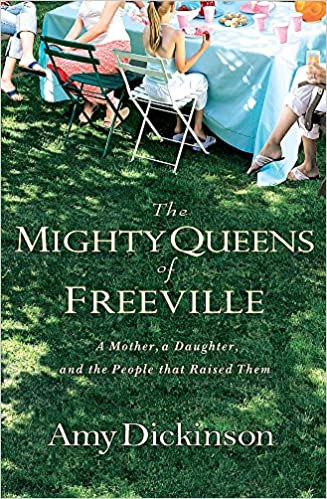
I swear I own The Mighty Queens of Freeville by Amy Dickinson, but I can’t find it anywhere. It was loaned to me, but the cover is SO familiar. And, how pleased I was to have finally read it. “After an exhaustive countrywide search, the Chicago Tribune announced Amy Dickinson as the next Ann Landers. They wanted a contemporary voice and they found it. Bracingly witty and honest, Amy’s voice is more Nora Ephron than Dear Abby. Readers love her for her brutal honesty, her small-town values, and for the fact that her motto is ‘I make the mistakes so you don’t have to’. Her advice column, ‘Ask Amy’, appears daily in more than 150 newspapers across the USA, read by more than 22 million readers. In THE MIGHTY QUEENS OF FREEVILLE, Amy Dickinson takes those mistakes and spins them into a remarkable story. This is the tale of Amy and her daughter and the women in her family who helped raise them after Amy’s husband abruptly left. It is a story of frequent failures and surprising successes, as Amy starts and loses careers, bumbles through blind dates and adult education classes, travels across country with her daughter and their giant tabby cat, and tries to come to terms with the family’s aptitude for ‘dorkitude’. Though they live in London, D.C., and Chicago, all roads lead them back to her original hometown of Freeville (pop. 458), a tiny upstate village where Amy’s family has tilled and cultivated the land, tended chickens and Holsteins, and built houses and backyard sheds for over 200 years. Most important though, her family has made more family there, and they all still live in a ten-house radius of each other. With kindness and razor-sharp wit, they welcome Amy and her daughter back weekend after weekend, summer after summer, offering a moving testament to the many women who have led small lives of great consequence in a tiny place.” Turns out, Amy’s daughter went to the school where I work (not that she mentions that except in passing in the book) and the local aspect made me enjoy it even more. And, it was the second book I have read in a week where the character live at the Kennedy-Warren. Funny. This is a delightful, short memoir, and well-worth reading. It’s laugh-out-loud funny in some places and dear in others.
I followed one Maine book with another. Haven Point by Virginia Hume is just the kind of story I like, multiple character’s stories over time. And it was SO engrossing. I had trouble putting it down, which hasn’t happened for me in a while. “1944: Maren Larsen is a blonde beauty from a small Minnesota farming town, determined to do her part to help the war effort––and to see the world beyond her family’s cornfields. As a cadet nurse at Walter Reed Medical Center, she’s swept off her feet by Dr. Oliver Demarest, a handsome Boston Brahmin whose family spends summers in an insular community on the rocky coast of Maine. 1970: As the nation grapples with the ongoing conflict in Vietnam, Oliver and Maren are grappling with their fiercely independent seventeen-year-old daughter, Annie, who has fallen for a young man they don’t approve of. Before the summer is over a terrible tragedy will strike the Demarests––and in the aftermath, Annie vows never to return to Haven Point. 2008: Annie’s daughter, Skye, has arrived in Maine to help scatter her mother’s ashes. Maren knows that her granddaughter inherited Annie’s view of Haven Point: despite the wild beauty and quaint customs, the regattas and clambakes and sing-alongs, she finds the place––and the people––snobbish and petty. But Maren also knows that Annie never told Skye the whole truth about what happened during that fateful summer. Over seven decades of a changing America, through wars and storms, betrayals and reconciliations, Virginia Hume’s Haven Point explores what it means to belong to a place, and to a family, which holds as tightly to its traditions as it does its secrets.” (Amazon) This was a great book, engrossing, and surprising. I highly recommend.









 Read Between the Wines